


 Location :
DVB-T Terrestrial Field Testing
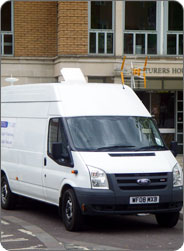
Digital TV Labs operates DVB-T Field Testing throughout Europe using specifically customised testing vehicles
Download:
Clients have access to low-cost, structured and rigorous testing in a mobile laboratory with complete coverage of all regional variations. With detailed problem reports, recorded streams and accurate RF measurements, clients can quickly understand and reproduce issues for a rapid resolution. We provide three types of field testing services;
♦ Standard field testing tours
♦ Hosted custom field testing services
♦ Portable device field testing
Standard Field Testing Tours
This low-cost service consists typically 20 to 30 sites across 15 to 20 countries. We do in-depth RF performance testing and system software validation. These tours last 5 weeks and are repeated every two months. Our mobile test lab is fully equipped for mobile (Doppler) testing. We cover DVB-T, analogue TV and DVB-H tests.
Hosted Custom Field Testing
Our custom testing allows up to three client engineers to join the testing for receiver optimization or debugging. Our fully equipped mobile lab ensures customers can focus of testing, optimisation and debugging at any location without loosing valuable time with logistics.
Portable Device Field Testing
We provide testing of portable devices at multiple typical locations (cafe, bar, train station etc) in selected cities. Our in-depth knowledge of European DVB-T conditions and local knowledge ensure an excellent representative test coverage for portable devices in real user situations.
 |
Why Use Digital TV Lab's Field Testing Service?
Our field testing avoids all the limitations of using in-house engineers in hotels or amateurish tests in a hire car.We have expert knowledge of where to test in Europe; we can carry bulky test instruments and using our expert knowledge we are able to test at the optimum locations. Europe is the world??s most expensive continent in which to travel. Our field testing prices are a fraction of the typical costs incurred through in-house testing, avoiding expensive hotel bills, subsistence, plane tickets and car hire costs.
Digital TV Static RF Measurements
The digital receiver is tested on each available channel for video and audio quality initially at the normal signal level . We then progressively attenuate the signal until video break-up (QEF point) and provide a comparison reading for minimum sensitivity against a standard reference receiver.If available, we will collect Bit Error Rate (BER) or Frame Error Rate (FER) and any other pertinent data from the receiver under test. |
Digital TV System Software Tests
Our field system software testing ensures that the key features of the receiver are validated in a variety of real broadcast conditions. A common challenge for field testers is to understand what the required behaviour of the receiver should be in unknown field conditions. We perform detailed analysis of the live broadcast using automated custom tools providing a comprehensive snapshot for each multiplex of what services are available and how they should be presented. Our test engineers can quickly compare the performance of the receiver under test to this reference information and find discrepancies accordingly. The core broadcast functionality of the receiver is validated with particular emphasis on service installation and presentation.
Analogue TV Measurements
We test that the receiver can install all the various colour systems which are applicable in each country such as SECAM, PAL B/G, PAL D/K and PAL I. We check the performance compared to a reference receiver for response to and suppression of echoes, noise and interference. We record the DUT sensitivity of the receiver by comparing the signal level for colour loss with a reference receiver. Comparison of the audio decoding performance is made against the reference receiver and we measure audio sensitivity with varying signal levels. We check Teletext presentation against a reference receiver.
Locations
The standard field testing tours cover numerous sites in all of the major markets to ensure good coverage of regional variations and also to include countries with new DVB-T services. Using our extensive DVB-T knowledge base and years of experience, sites are carefully selected to include demanding RF conditions and challenging transport stream content. Locations include cityscapes, mountains, urban traffic, over-water reception, low level signals, high level signals, border areas and multi-path reception (within and outside of the guard interval). |
 A typical tour route |
Data Captured
We record detailed information at each site including comprehensive RF data using our on-board instrumentation from Rohde & Schwarz.
♦ Location GPS
♦ Site description
♦ Weather conditions
♦ Distance and bearing to principle transmitters
♦ Frequency and offset of each multiplex
♦ Modulation parameters
♦ Multiplex signal power
♦ Pre and Post Viterbi BER
♦ Analog interferer frequency and power
♦ Digital interferer frequency and power
♦ MER vs. Carrier plot
♦ Constellation plot
♦ Echo plot
♦ Device under test (DUT) sensitivity
♦ Reference receiver sensitivity
♦ Reference script with DUT video, audio, EPG, Teletext and Subtitle results
♦ Receiver defect list
♦ High quality digital photograph of specific DUT defects
♦ Transport Stream recordings for each multiplex (5 minutes)
♦ RF recordings (20MHz) centered on each Digital and Analogue channel (1 minute)
Problem Replication
We ensure that any field issues can be easily understood and recreated to enable a quick resolution in the development lab. Our experienced test engineers provide detailed error reports, with all relevant conditions of the site being carefully recorded. Using band analysis instrumentation and spectrum analysis the RF conditions and parameters can be captured accurately. A five minute transport stream from every multiplex available at the site is recorded enabling reproduction of software issues at a later date. When needed, software issues are duplicated in our Bristol Test Centre to ensure that clients can also reproduce the problems with their development teams. Detailed error reports are made and preliminary results are provided to the client during the tour. A final, comprehensive report is provided to the client on completion of the tour.
Receiver Platforms
We test a variety of products with DVB-T, DVB-H and analogue TV tuners including:
♦ Set-Top Boxes
♦ Integrated Digital Televisions
♦ Silicon Tuners
♦ Demodulators
♦ Semiconductor manufacturer development boards
♦ Portable Media Players
♦ Phone handsets
♦ PC and USB devices
Comprehensive Reports
Digital TV Labs provides spreadsheet reports containing detailed information on the test site broadcasts, DUT performance and reference receiver performance. We also provide a final report with correlated data and conclusions. Our clients often use our independent reports as sales tools for prospective customers.
| Count:9713


